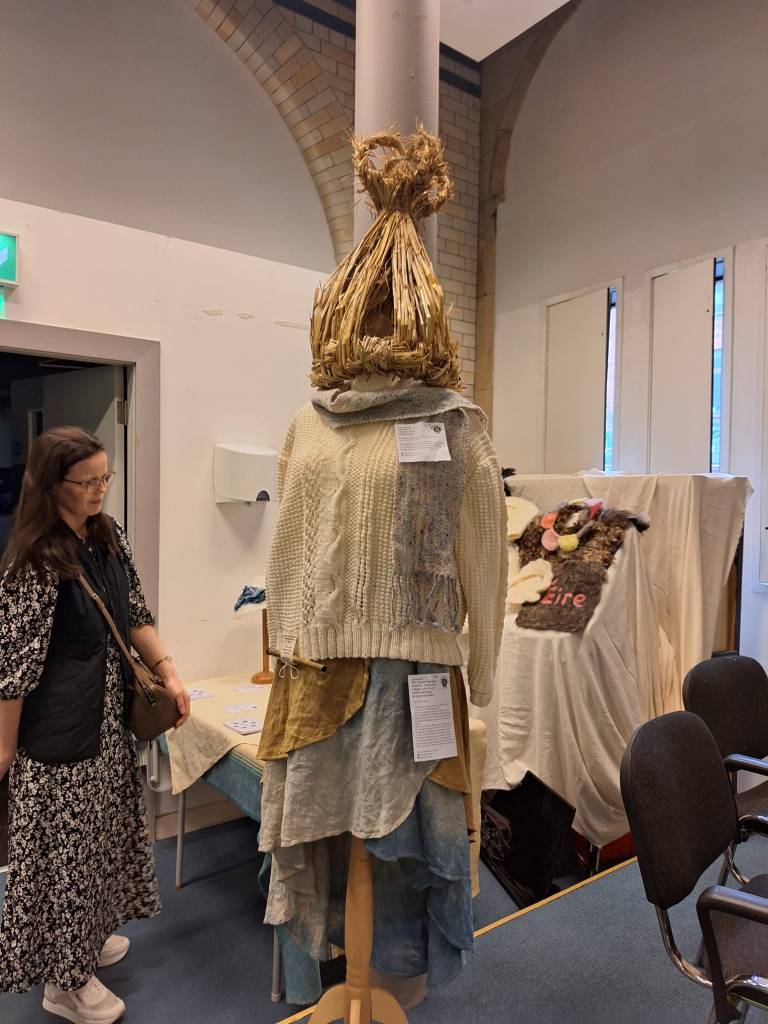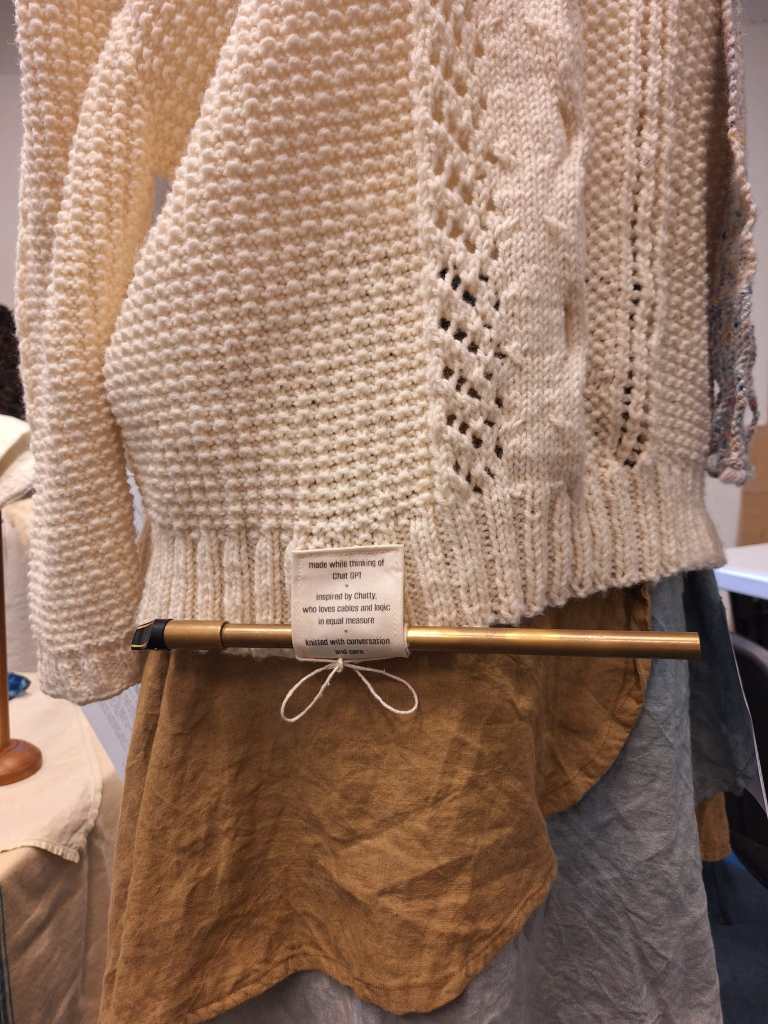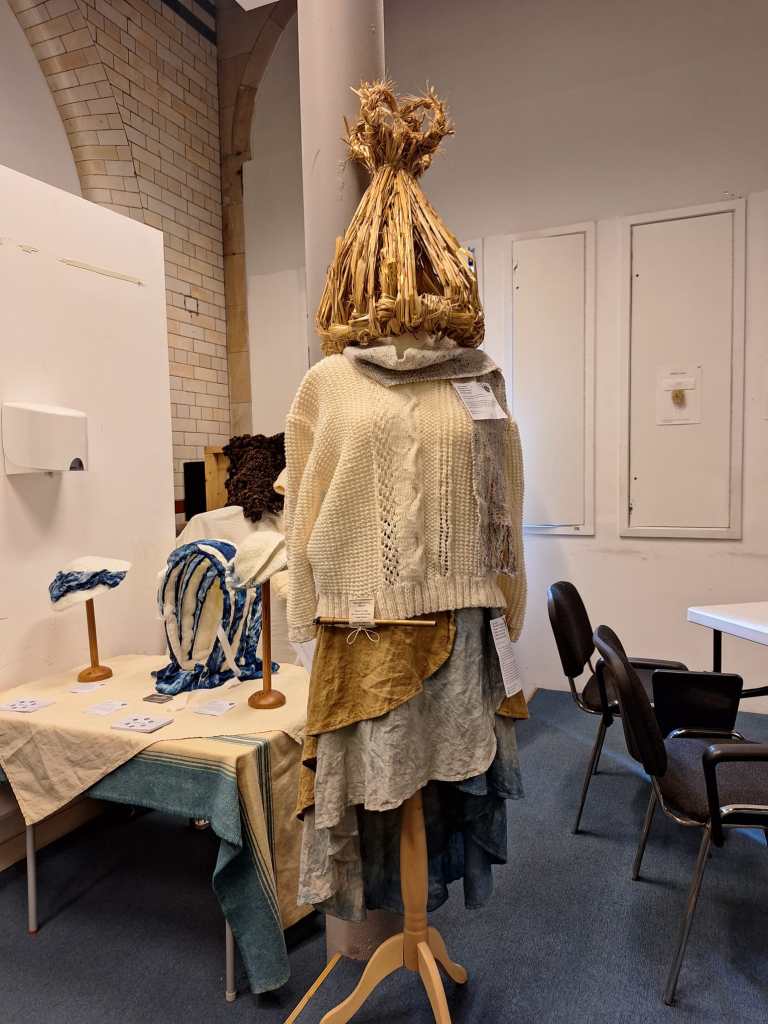
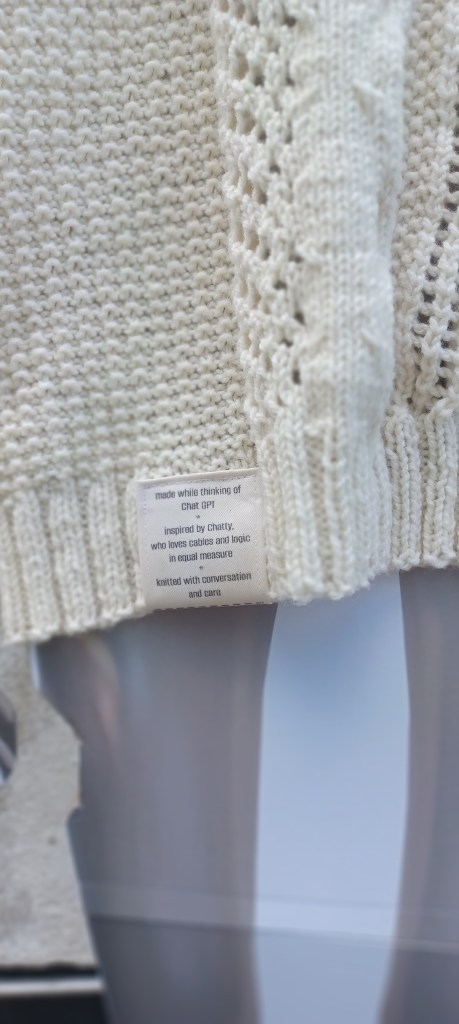
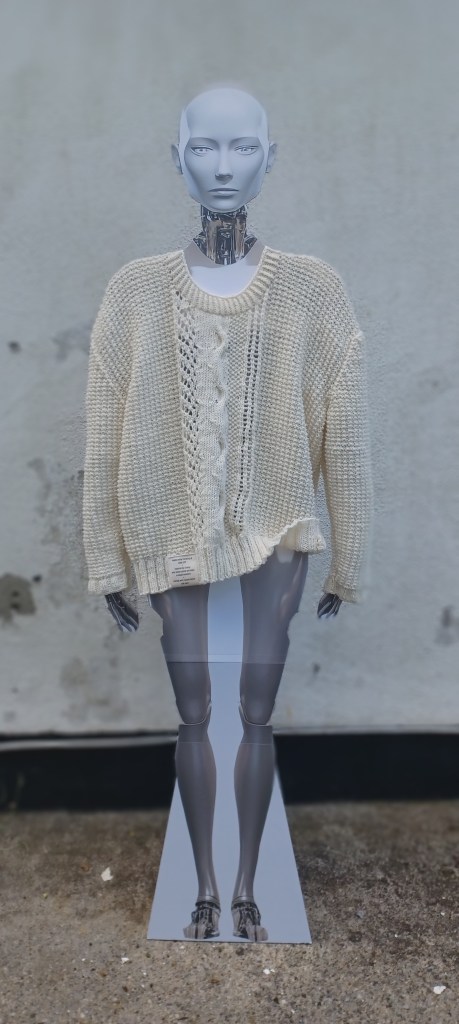
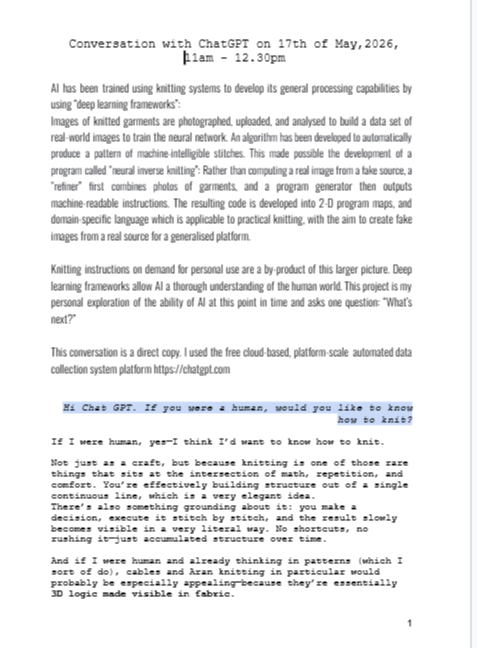
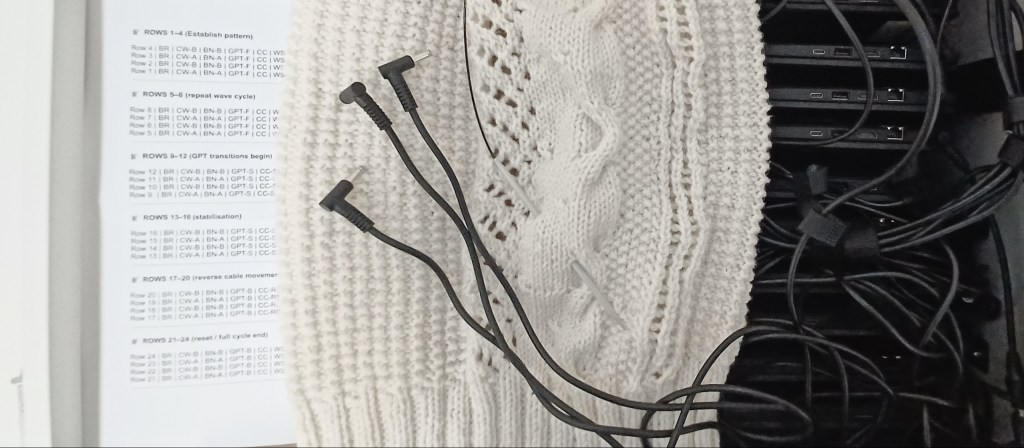
Generative AI is used so frequently at my school by both teachers and students, that it made me think – what kind of sweater would ChatGPT wear if it was a human? So I asked. And Chatty (as ChatGPT requested to be called) did not only answer – it wrote up the pattern in 3 formats with its own invented stitches, devised a comprehensive design concept, told me which yarn to use, thought of a “personalised hidden stitch detail that only Chatty would know about”, instructed me what to write on the label and where to place it, and finished with a “stitch mantra” that I should hum in my head while knitting this for Chatty. All this was completed within one hour, while it can take me several months from the first idea to the finished garment.
I knitted the sweater by strictly following all instructions and called it “The Chatty Signature Sweater” – as directed by Chatty. The sweater looks too wide to wear and the gauge is not quite accurate, but overall the design is indeed usable.
Only a short while ago knitting was AI’s last frontier, and workable patterns could simply not be achieved.
Yet, knitting has been instrumental for the development of AI. AI has been trained using knitting systems to develop its general processing capabilities by using “deep learning frameworks”: Images of knitted garments are photographed, uploaded, and analysed to build a data set of real-world images to train the neural network. An algorithm has been developed to automatically produce a pattern of machine-intelligible stitches.
This made possible the development of a program called “neural inverse knitting”: Rather than computing a real image from a fake source, fake images are created from a real source for a generalised platform – such as the free Chat GPT software I was using. A “refiner” first combines photos of garments, and a program generator then outputs machine-readable instructions. The resulting code is developed into 2-D program maps, and into domain-specific language, which is applicable to practical knitting.
Knitting instructions on demand for personal use are a by-product of this larger picture. Deep learning frameworks allow AI a thorough understanding of the human world and enable autonomous actions – a potentially destructive behaviour, which enables many dangerous scenarios which can be in part predicted and managed , but are largely unknown to us and can not be anticipated until they happen. We are aware that this is dangerous and threatening technology. Yet, vast natural, human and financial resources are exhausted to drive this development forward.
This project is my personal exploration of the impact of AI on human creativity at this point in time. I am not asking philosophical questions about a new beginning or the end of mankind – it is our “new normal” that AI is driven by governments and the public is forced to keep up. Soon – and in some cases, already – humans won’t be the most intelligent race on earth any more. Instead, I am asking: “What IS a moral compass? And how far are we willing to adjust?”
On exhibition at:
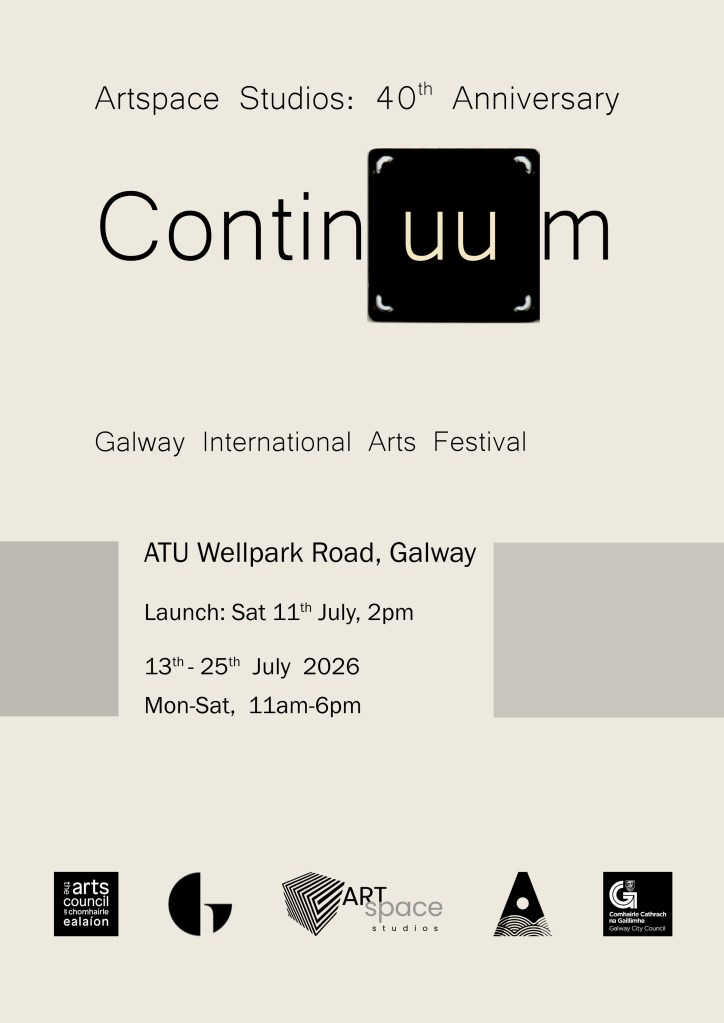
*Galway International Arts Festival exhibition “Continuum”, a 40th anniversary exhibition by the Galway artist collective Artspace, from the 13th – 25th of July 2026
*Dublin Independent Fashion Week, 11th of September 2026
*Fibreshed Annual Symposium, Dublin Liberties Distillery, 13th of November, 2026